James Joe Mullen: A Life in Cultivating Long‑Distance Pigeons
by Lewis McCalley
The County of Fife has long been steeped in the history and tradition of Scottish National pigeon racing, producing some of the sport’s finest exponents over many generations. It is a county where National performances have always been held in high regard, and where many outstanding fanciers are recognised as household names by those who know the game.
One Fife fancier who certainly caught the eye during the exceptionally difficult 2026 season was James Mullen, from the small village of Lumphinnans, better known throughout the pigeon racing fraternity simply as Joe. In a season that tested both pigeons and fanciers to the limit, Joe’s performances were nothing short of impressive and marked him out as one of the names worthy of closer attention.

His fabulous hen, Sandra, became the first Scottish National Flying Club Gold Award winner in seven years, such is the difficulty of achieving this accolade in the modern era. Even more remarkable is the fact that all five of her qualifying performances came from the SNFC’s blue-ribbon Gold Cup event. The tip of the iceberg, however, came in the form of her daughter, Louise, who went on to finish 1st Section C, 1st East Region and 2nd Open after an incredible 14 hours on the wing.
Although I had been aware of Joe’s fantastic performances in the long-distance races, I first met him and visited his home just a couple of years ago. I was instantly impressed, both by Joe himself and by the quality of his birds.
It’s not often you see what could genuinely be described as a family of pigeons-the product of many years of careful selection, breeding and rigorous testing. The resilience and perseverance required to develop such a family in the modern sport are rare qualities indeed. Beyond this, it was immediately evident that Joe is a real student of the game. His unique perspectives and ideas on pigeon keeping are both thought-provoking and, in my opinion, worthy of sharing with the wider fancy.
One of the things that has always fascinated me about pigeon racing is that there are no real rights or wrongs, nor are there any absolute truths. With that in mind, here are some thoughts and opinions from a modern-day great, expressed in his own words.
I hope you find this question-and-answer session interesting, insightful and, in some way, useful.
How did you first get into keeping pigeons Joe?
As a young lad, my world revolved around feathers long before racing pigeons ever entered the picture. I had an uncle who bred budgerigars and was well known throughout Scotland for producing birds of real quality. His reputation stretched far beyond our village,
I wasn’t far behind him. In my own small hut, I bred budgies for neighbours, learning the basics of pairing, feeding, without ever realising those early lessons that would shape the rest of my life. At home, my father and his brother kept hens-not for sport, but for eggs and food. Birds were simply part of the rhythm of daily life. But one day, everything changed. A man asked permission to erect a pigeon loft on my uncle’s three‑acre plot, that moment was my first encounter with racing pigeons and love of the same.
I was fascinated. The stories of pigeons in the war, watching them arrive from races, cutting through the sky with purpose, something inside me clicked. A loft was built. Pigeons were acquired. The spark was lit. And then along came Sandra. Yes-the pigeons were pushed to the back of my mind for a few years. Life has a way of rearranging your priorities when you’re young and discovering the world. But even then, one passion never left me. My interest in the greyhounds.
You raced greyhounds too?
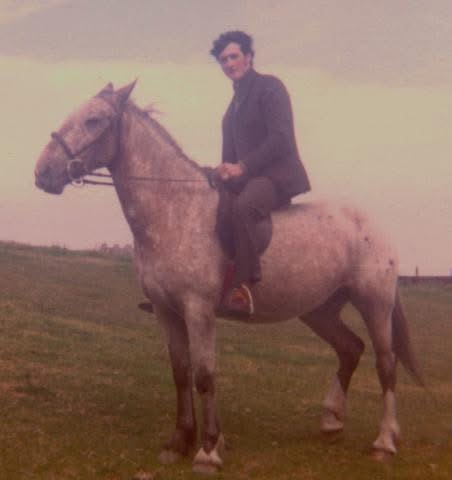
Yes, Early days in the 60s were spent with a love of greyhound racing at the local tracks and later while courting my now wife Sandra who also enjoyed the hobby as her father also a fanatic soon had me sharing his passion for all animals which included Horses, Cattle, Goats, Geese, hens, etc. Sandra looked after the incubators and each year 1.000 turkeys were reared just in time for Christmas. all types of dogs were kept but mostly greyhounds. The highlight of the greyhound racing then was Sandra's dad winning the Scottish greyhound Derby held at Ashfield stadium approx. 1963 with a greyhound called "Golden Boy" the prize for winning the final was £1000 such was the interest in those days. We always prided ourselves on the condition of our greyhounds and this was evident from comments at the tracks. We of course had a big advantage when it came to training our dogs as we had a 200 yard straight track at our kennels with trap, as well as more than enough room for them with runs adjacent to kennels.
From keeping birds and racing greyhounds, how did your interest in pigeons develop?
An interest in pigeons was always there in the background, and eventually a loft was built on the 15 acres of land that Sandra’s dad had a lease on. The first notable success came from Cheltenham, approximately 300 miles, when a mealy hen won the section in Fife Fed, also taking the club by an impressive 20 minutes.
Over the years, club membership dwindled from its peak of 30 members, but the winning performances remained consistent. Among the notable results was 1st Section, 2nd Open Fife Fed from Lymington, 400 miles, with Sandra’s Girl, a red chequer hen gifted as a youngster by club member and farmer Jimmy Kirkland. She was bred from two pigeons obtained from Wullie Wilson of Larkhall.
Following those excellent inland results, how did you go about achieving your first success at cross-channel racing?
It’s always good when the family can become involved in the sport, and a mealy cock certainly managed to do just that. He would walk around the garden and even make his way up the steps into the house. If we turned on the tap in the kitchen, he would fly up and enjoy a splash in the sink. To the family, he had become something of a pet.
However, I was a little disappointed with his race results. A lad called Rusty Clarke had just started working with me and, one lunchtime, he told me that he lived in Kilmarnock and travelled from there to work each day-a distance of 58 miles as the crow flies. Rusty had no objection to taking a small basket with him containing the mealy cock, and this went on for three weeks, four times a week.
He was liberated at 6:30 p.m. each evening and gradually became quicker with every flight. The week before the French race, he had open loft as usual.
On the day of the race, as we had no telephone in those days, Stirling Kirkland arrived at our house to tell us that the weather was bad down south. With low fog across the Forth, it didn’t look particularly promising for day birds.
Yes, you guessed it-along came the mealy from the west, where it was probably clearer, to finish 11th Open.
What other early successes do you remember, and were there any particular pigeons that left a lasting impression on you?
A good Blue Bar hen who won 210th Open, 68th Section C from Rennes with the SNFC, flying 1,049 yards per minute from a field of 4,175 birds in 1986. The following year, she won the 236th Open, 115th Section from Rennes with the SNFC, from 3,854 birds. In one of these races she won £800, which certainly came in handy with a young family. She was also a great club racer winning pools regularly.
I recall when she had topped the West Fife Section from 290 miles. As she approached the loft, she suddenly veered away towards a nearby field. I began to wonder if it was actually her at all, but after a few minutes she returned to the loft and trapped normally.
She was a quiet-natured hen, and the fact that she had gone to the field had me walking along to see what had attracted her. There, I noticed some newly sprouted grass with a light covering of rainwater, which seemed to be the only attraction on what was a very warm day. I added a supplement to the loft drinking water and, interestingly, she no longer visited the field when the birds were given an open bowl.
Her first arrival from Rennes, late in the day, was also quite eventful. I was working night shift at the time, so Sandra’s father was on watch. However, he was unable to contain his excitement when she arrived. He climbed onto the roof of the feed hut to usher her towards the loft, only to put his foot straight through the roof !
Sandra, meanwhile, picked the hen up and duly timed her. A phone call was then made to Jimmy Hamilton, clock convenor who exclaimed that he knew of no other arrivals in Fife and told us to bring the clock to his house as soon as possible.
A visit to Eddie Newcombe around 1980 resulted in the purchase of a mealy cock, a son of Mealy Prince, along with a blue chequer hen. The mealy cock became known as St Finnan Producer, and he went on to become an exceptional breeding pigeon.
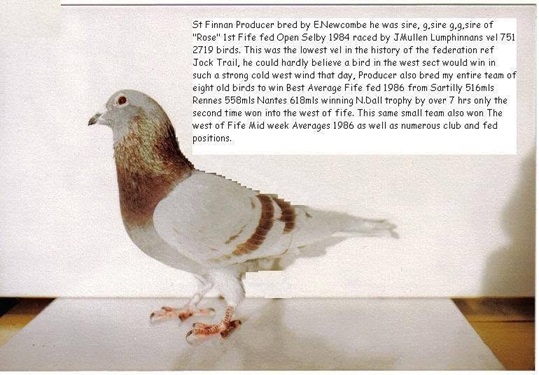
He was the sire of eight old birds that won the Best Average in the Fife Fed from Sartilly, 516 miles; Rennes, 558 miles; and Nantes, 618 miles, in 1986-winning the average by more than seven hours.
I particularly remember one of his sons, he was 40th Open Nantes, 618 miles, in the SNFC in 1986, from a race with 1,195 birds. I can still recall his arrival on a very warm day he landed on the roof of the loft he was totally exhausted and I had to take time to talk him down, I lost at least 5 minutes.
Another son, a yearling, arrived from Sartilly that same year while I was sitting with my father-in-law. He exclaimed, “Was that bird in France this morning?” It was the first time he had seen a pigeon timed on the day from France.
A daughter of St Finnan Producer arrived just before 4am to clinch the fed averages, when clubmate Kenny Paris arrived at around 6am. I remember telling him, “Nothing yet,” as I knew he would look into the loft-which he duly did, his shocked look on seeing her gave us much amusement. There were a few drinks enjoyed in the morning sunshine before Sandra had to drive me to the clock checking.
Another of his sons was 53rd Section, Nantes, 618 miles, SNFC, in 1987, from 1,042 birds.
The mealy cock also proved himself as a sire, grandsire and great-grandsire of Rose, few pigeons linebred as such would have the stamina winning 1st Open Fife Fed from Selby in 1984. This was achieved at the lowest winning velocity ever recorded in the history of the Fife Fed’s young bird Open race-a remarkable performance made even more impressive by the extreme cold west wind.
That race was more or less the last time I flew young birds. The old bird team that had raced so well had not been raced or trained as youngsters, only flying from the Open Bowl, and this experience had a big influence on my thinking around how I handle young birds.
So, am I right in saying that you haven’t raced youngsters since 1984?
Yes, in 1984 I had a great young bird team, winning the Fife Open as well as all of our club races. Yet, none of those birds were up to the same standard the following year. By that time, I was becoming convinced that young bird racing simply wasn’t doing the job. In fact, I felt it was only producing sheep.
I recall late one evening, watching my team flying around the loft. Darkness was approaching, so I decided to call them in. Imagine my surprise when 16 young birds trapped with them these birds belonged to another local fancier. When I phoned the club secretary, he was amazed and informed me that the birds were his.
I also remember another occasion when I was sitting with Kenny Paris and the phone rang. A fancier 40 miles to the west had found a blue pied with a damaged leg land on his loft alongside the rest of Kenny’s team. The fancier had got Kenny’s phone number from the ring on one of the birds. These birds had not yet been in a basket, but, sure enough, about an hour later they arrived back at Kenny’s loft, accompanied by the limping pied.
I look at young birds almost as I would children. Those youngsters dropping in with established teams are a perfect example of just how powerful the flocking instinct is in young birds. Before they have experienced basket training, before they have had any roadwork and before they have even learned the geography of their own surroundings, they will still lock onto a confident, purposeful group and follow it.
My team consisted of old and young birds flying with real intent, and those youngsters simply glued themselves to the strongest ‘signal’ in the sky. I believe orientation is genetic long before it is trained. The flocking instinct is, after all, a survival mechanism. Youngsters will follow a confident team even if it takes them miles away from their own course, and it is often only later, when the group disperses, that panic sets in.
My young birds are never separated from the old birds; they live together as one flock. The young birds are not raced. They are simply allowed open-bowl freedom and plenty of opportunity to fly with the old birds. They are mostly very tame and will walk into the conservatory looking for Sandra to give them a few peanuts.
I often have fanciers comment on their quiet disposition, which I regard as a real asset when they eventually go into the basket. They are not easily stressed, and I believe this helps them remain settled and relaxed during their journey to the races.
Taking into account that you have won the Kardale Trophy for the first yearling from the SNFC Gold Cup race several times, yet you do not race or train your youngsters, what treatment do your pigeons receive as yearlings?
Old birds, along with last year’s youngsters, including latebreds, are given five tosses of approximately 20 miles before racing starts. . They then receive five single tosses from the direction the birds enter the federation area. After that, they receive club racing every week, along with a single up twice mid-week. I then hope to give them 8 hours on the wing 2 or 3 weeks prior to the Gold Cup.. That’s enough time on the wing no need for anything else. After that, there are no more tosses, as you can burn up the very reserves the birds need. Overtraining can deplete the fat reserves required for the final third of a 10–15-hour race. Long-distance pigeons are not made fitter by more and more training; they are made stronger through gradual conditioning and by introducing fats gradually in the two weeks before basketing.
I also give the birds as much freedom as possible.
Yearlings are fragile in one particular way: their reserves are shallow, and once you drain them through rearing, they may never fully recover in time for a hard old-bird campaign. Rearing two youngsters is probably the single biggest energy drain a yearling can face. It costs more than any toss, more than any race and, in some respects, more than anything else you can ask of the bird.
A pair feeding two youngsters can lose up to 25–30% of its muscle protein over the cycle. Yearlings simply don’t have the depth of reserves to replace that quickly. Fat is the fuel for distance, and rearing two youngsters can empty the tank.
You’ve seen it yourself: yearlings feeding hard can lose their bloom, shine and tightness. Young cocks feeding two babies can become dull and lose their sharpness and drive. A mature pigeon of two to seven years old can bounce back from this far more readily. A yearling cannot recover as easily.
It is interesting that you keep your old birds and young birds together as one flock. Can you tell us a little more about your thinking behind this and share some of your ideas on the benefits of managing them this way?
On the subject of separating young birds from their parents, I really believe the parents are their teachers. The youngsters learn so much from them-how to stay calm, behave around the loft, mix with the flock and, perhaps most importantly, build confidence. When you remove the parents, you are also removing a big part of that natural education.
I’ve also found that leaving the youngsters with their parents seems to help with their immunity, and I have far fewer health problems as a result. In fact, young bird sickness is virtually non-existent.
It’s interesting that you feel this helps reduce health problems. Health is wealth, as they say, isn’t it?
A pigeon can have the very best genetics, but if its condition is even slightly off, it can become just an ordinary pigeon. I think the best fanciers understand that health isn’t about one particular thing-it’s about getting lots of small things right and having them all working together.
You want clear, easy breathing, with no noise or irritation. The digestion needs to be good, with consistent droppings and the pigeon making the most of the food it’s getting. Feeding also has to be balanced, providing the carbohydrates needed for speed, fats for the longer distances and protein for recovery.
Fitness is another important part. I prefer steady, controlled preparation rather than forcing birds or overtraining them. And, of course, the loft environment plays its part too-it should be dry, well ventilated, calm and as consistent as possible.
Good condition is built gradually. You can’t rush it and you certainly can’t force it. When a pigeon is in really good health, you can see the difference. It flies smoothly and economically, with a confidence and ease that is difficult to describe, but you recognise it straight away.
Breeding gives a pigeon the ability, but it’s good health and condition that allow it to show that ability. If a pigeon isn’t right physically, it simply can’t show you what it has got.
When it comes to keeping your pigeons healthy, are there any particular things you feel are important in terms of feeding?
Not all pigeons will respond to the same mixtures, so I’m reluctant to recommend any particular one. For instance, my birds are small to medium-sized, and about two weeks before a National race I slowly introduce Hi-Fat Energy Plus. However, I believe this only works with pigeons that are genetically built for endurance. Their bodies are naturally equipped to use fat efficiently as fuel. If a pigeon isn’t built that way, too much fat can make it feel heavy, slow and even lethargic. Instead of being converted efficiently into energy, the fat may simply be stored, putting additional strain on the liver.
The days of having hoppers full of beans aren’t really my idea of feeding pigeons. I prefer a mixture containing as wide a variety of grains as possible. Every grain can vary from year to year-in protein, oil content, density, moisture and even how easily it is digested. That’s why, for me, a good varied mixture is the safest approach.
Are there any supplements or additives that you find particularly beneficial for your pigeons?
I try to avoid using antibiotics unless they are absolutely necessary.
I do like to use electrolytes for rapid rehydration after hard exertion, particularly following a tough race, but I prefer to avoid them before basketing.
With birds bred to race 500–600 miles, I believe their biggest requirements are efficient fat metabolism, muscle repair, good hydration, gut stability and a proper mineral balance.
With that in mind, I use wheat germ oil two or three days a week. The day after a particularly heavy training period, I’ll use amino acids, and I give probiotics once or twice a week. Minerals and grit are available to the birds at all times.
I also like to use cider vinegar with the ‘Mother’, but I prefer putting it on the grain rather than in the drinking water. That way, there is no effect on the birds’ water consumption. They continue to drink normally, which I think is crucial for maintaining electrolyte balance and proper kidney function. Reduced water intake is something I certainly don’t want during racing preparation, particularly with old birds being conditioned for hard days.
When the vinegar is applied to the grain, it goes into the crop with the food and, in my view, helps with digestion and the breakdown of the grain. You also know that every bird is receiving the same amount, whereas putting vinegar in the drinker can result in birds taking different amounts depending on how much they drink.
I use around 5–10 ml per kilo of grain, mixing it thoroughly until the grain is lightly coated. You can also add brewer’s yeast or a probiotic powder afterwards, as the vinegar helps it bind to the grain.
I use this two or three days a week, and I find it works particularly well after a hard race, when the birds can sometimes be reluctant to drink heavily.
You touched on the role the loft plays in keeping the birds healthy. Can you describe your loft and explain what you feel is important about its design?
My loft is 20 feet by 8 feet, with an apex tiled roof and a skylight. The back of the loft faces west, which is important here because the prevailing winds in Scotland generally come from that direction. The wind hits the back of the loft first and then moves through towards the front.

I have a 10-inch vent running the full length of the loft just below the apex, which allows the incoming air to move through, while a vent of the same size at the front allows the air to be drawn out. This creates a good pressure and airflow through the loft, with the air moving quickly and cleanly above the heads of the pigeons rather than sitting around them.
The back and sides are made from two-inch-thick timber, which I’ve subsequently covered with mesh and harled. That helps prevent cold, damp air penetrating the loft and also reduces the risk of condensation forming inside. The thickness of the timber helps the loft retain enough warmth for moisture to rise and escape, while still allowing the building to breathe. You don’t get the same “sweating” problem you can have with thin plywood or metal.
The front is built with red common 65 mm facing brick, with two central louvred doors that open up to around 6 feet by 6 feet. Brick holds heat for longer and helps create a stable extraction zone for the apex vents and louvred doors. It gives you a warm, dry front wall that encourages the air to move upwards.
I find the loft almost regulates itself according to the conditions. On windy days, the airflow increases naturally. On still days, the apex vents continue to draw the warmer air upwards. In hot weather, the brick front helps prevent the loft from overheating, while in cold, damp weather the two-inch timber and harling help keep the dampness out.
For me, the whole idea is to create a loft with a constant movement of fresh air without creating a draught directly around the pigeons. I want the birds to be dry, comfortable and breathing clean air, whatever the weather is doing outside.
You’ve described the loft, so now let’s talk about the residents. Your birds could certainly be described as your own family, but every family of pigeons has its origins. What can you tell us about the origins and foundation of your family?
In 1992, I purchased several youngsters from Joe Murphy, including a blue chequer hen, SU92F4890, bred from SU88E03518, a pure John Ellis of Elphinstone pigeon. She was a winner of four SNFC prizes and a granddaughter of Lothian King and Lothian Queen.
I also purchased cock 4876, a full brother to Joe’s Lady Janet, which was 5th Open SNFC. His pedigree contained the Rowena lines, bred and raced by Dennis Dall, including his famous Rowena, winner of 1st Open SNFC Niort, 697 miles, in 1990, as well as 79th SNFC Sartilly, 135th SNFC Rennes and 51st SNFC Niort in 1989.
Another purchase was 4875, which also carried the Rowena bloodlines. When 4875 was paired to 4890, they bred St Finnan Messac Lad. As a two-year-old he flew the 1997 Rennes smash, missing the result but returning in great condition. He later proved his class, winning 128th Open, 49th Section SNFC Rennes and the same positions at Messac, 577 miles. He also won the best two-bird average in the Fife Federation with St Finnan Power, a daughter of 4876.
St Finnan Messac Lad was then paired to a chequer pied yearling I bought at Joe Murphy’s clearance sale for £400, 19294, St Finnan Mystical Pied. Her dam was Joe’s Mystical Rose, whose sire was a red cock bred by Victor Lough of Dunbar, a son of Temperance. Temperance scored four times in the SNFC, including 24th Open Stafford, 3rd Open Dorchester and 7th Open SNFC Young Bird National from Worcester, all within seven days. His sire was Champion Rhythm, a five-time SNFC Gold Award winner and multiple Channel winner.
Mystical Rose also had an impressive pedigree. Her dam came from a pair of eggs given by John Bosworth of Elphinstone to Kevin Murphy, bred from his 19th Open SNFC Appledore winner, with the sire tracing back to John Ellis of Elphinstone’s Lothian Lass line.
Mystical Rose herself was 8th Fife Federation Open Sartilly as a yearling, the only day bird in the club after 16 hours 45 minutes on the wing, covering 515 miles. At three years old she went 20th Section, 83rd Open SNFC Sartilly, followed by 144th Section, 236th Open SNFC in 1992, and then 1st Open SNFC Sartilly from 3,292 birds.
She was paired to 7254, a direct son of John Ellis’s Lothian Lass, a remarkable racing hen who won the SNFC Gold Award and recorded Open positions of 21st, 8th, 24th, 11th, 77th, 248th and 128th. She also won the Dewar Trophy for the best pigeon in Scotland in 1987. One of her sons later bred 1st Open SNFC Rennes for Dale Newcombe.
The breeding continued to produce some outstanding pigeons. St Finnan Mystical Pied and St Finnan Messac Lad bred St Finnan Girl, 154th Open, 43rd Section SNFC Reims and the third yearling into Scotland. Her brother, 16739, bred St Finnan Lady, 61st Open SNFC Liege on the day.
I also borrowed a brother to 14433 from Kevin Murphy, bred from Mystical Rose when she was paired to the brother of Dennis Dall’s Rowena. This cock was paired to Mystical Pied and produced St Finnan Mystical Produce. He went on to sire St Finnan Blue, 70th Open, 51st Section SNFC Reims, and St Finnan Pride, 21st Open, 17th Section SNFC Liege.
St Finnan Pride was the grandsire of St Finnan Lad, who won 22nd Open, 18th Section SNFC Liege, arriving as the first yearling into Scotland and winning the SNFC Kardale Trophy.
What made this particularly special was that St Finnan Pride, St Finnan Lad, St Finnan Girl and St Finnan Lady were all timed on the day from the Liege Gold Cup, producing the best two-, three- and four-bird averages into Scotland.
St Finnan Mystical Produce was later paired to a daughter of Priceless Rose, 4878, crossed with a son of Joe’s Choice bred by Tom McEwan, from the sire of his Dewar Trophy winner. This pairing produced the mother of St Finnan Rose, who went on to win 8th Open, 4th Section, 2nd Region SNFC Reims, arriving with St Finnan Lass, who was 7th Open.
Meanwhile, 4876, the brother of Lady Janet, was paired to a Jan Aarden hen from Ian Axe, known as St Finnan Birthday Girl. They bred St Finnan Power, who recorded 111th Open, 59th Section SNFC Rennes in 1998; 81st Open, 31st Section Rennes in 1999; and 175th Open, 70th Section Messac Gold Cup, 577 miles, in 2000. Her Rennes velocity in 1999 was 1080, and she again featured prominently at Messac. Along with St Finnan Messac Lad, she won the best two-bird average in the Fife Federation.
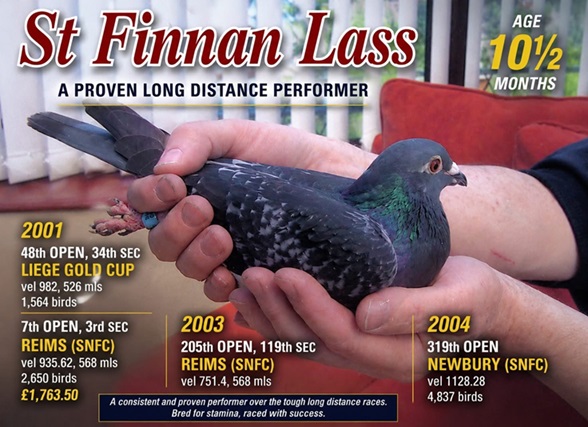
St Finnan Lass was another exceptional hen. At just 10½ months old she was 48th Open, 34th Section SNFC Liege Gold Cup, 526 miles, in 2001. The following year she was 7th Open, 3rd Section SNFC Reims, 568 miles. She later recorded 205th Open, 119th Section at Reims in 2003 and 319th Open SNFC Newbury in 2004. She arrived from Tours in race time while I was at the clock station and would have been on the result had I been there. She eventually retired after winning four National certificates.
Her dam, St Finnan Axe, was bred by Ian Axe from his best Robert Venus Supercrack lines, while the sire was from Dale Newcombe and John Ellis of Elphinstone bloodlines.
Our first visit to Liege was a memorable one. Club member Peter Drummond was there and witnessed the arrival of four birds that night: St Finnan Lad, a yearling who won the Dale Newcombe Trophy, St Finnan Pride, St Finnan Lady and St Finnan Lass at just 10½ months old.
Those four pigeons would later feature heavily in the pedigree of what became known as the “Mullen Cock”, purchased by Dale Newcombe at an SNFC sale. The first bird he sired was Kardale Black Velvet, who went on to win 8th Open SNFC Tours. David Jamieson purchased him at Dale’s sale for £1,000. Looking through pedigrees at the sale, David said it was obvious he was being used frequently by Dale and had the potential to be an excellent breeder, and at Dave’s loft he certainly left his mark, becoming the grandsire, on the dam’s side, of White Mick.
St Finnan Lass and St Finnan Rose being 7th and 8th Open SNFC 568mls 2,650 birds was a tough act to follow, however.
After three years away from racing because of work commitments, I visited Jim Donaldson, who became a great friend and introduced me to some of the finest distance blood in Britain.
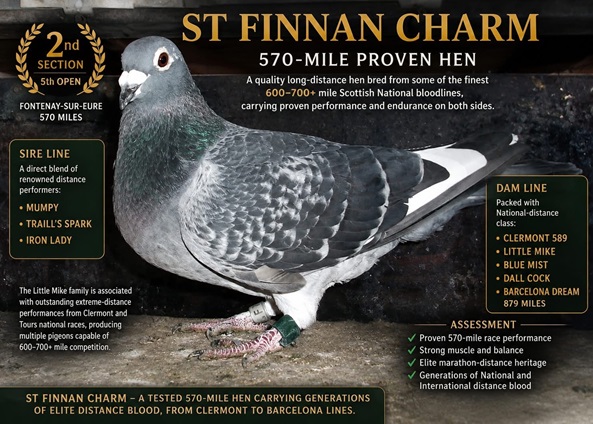
During one visit, Jim and Anne brought me a hen I named Sweetheart. Her dam was the legendary Reims Girl, while her sire was Little Mike. As Jim handed Sweetheart to me, he said, “If you ever have to give up the birds, she comes straight back to me.”
Reims Girl was an extraordinary racer, winning 1st North Section, 52nd Open SNFC Reims in 2002, then 1st North Section again the following year. She went on to win 2nd North Section, 707 miles from Tours in 2004, and 2nd North Section, 7th Open from Tours in 2005, on both occasions beaten only by loftmates. She was undoubtedly one of Britain’s great 600–700-mile performers.
Little Mike was no less impressive, with 2nd Section, 7th Open from Clermont, 589 miles, in 2002, followed by 1st Section, 4th Open from Tours, 707 miles, in 2005. So Sweetheart was bred from a truly exceptional pair.
My next important visit was to John Ellis of Wellbank, known as “The Maestro.” I purchased a dark chequer cock from him, bred from the Wellbank Lass and Wellbank Reliable lines, both SNFC Gold Award winners. Wellbank Reliable herself went back to Wellbank Faithful, another Gold Award winner.
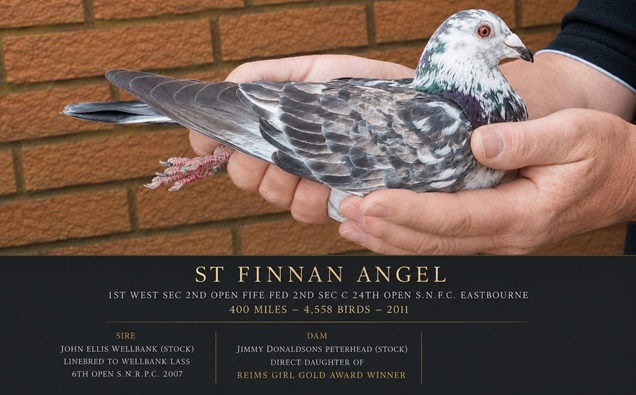
The first yearling I tested from this cross was St Finnan Angel, who won 1st Club, 1st West Section, 2nd Open Fife Federation, 2nd Section and 24th Open SNFC Eastbourne in 2011. That convinced me the cross had real potential.
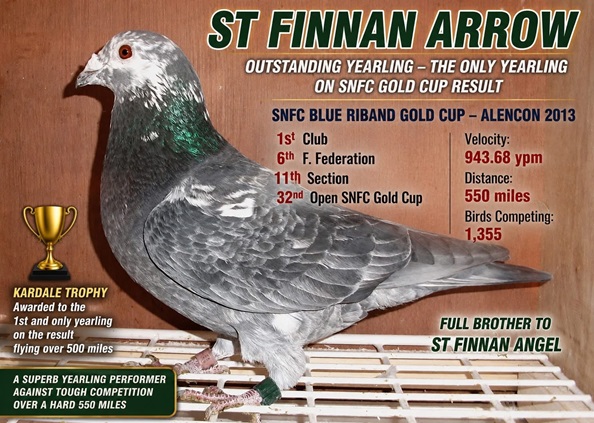
Then came St Finnan Arrow, 1st Club, 6th Federation, 11th Section and 32nd Open SNFC Gold Cup Alencon in 2013, winning the Kardale Trophy as the only yearling on the result. Other outstanding racers followed, including St Finnan Louise and St Finnan Skydiver.
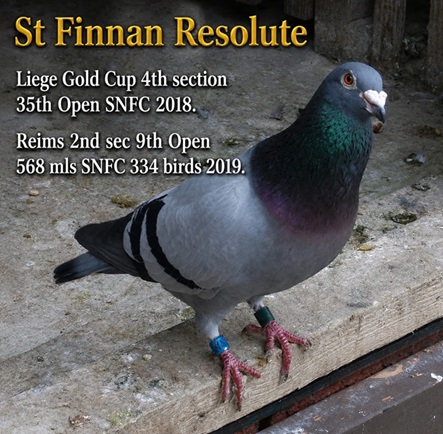
Skydiver was a particularly important cock. He won 12th Section, 59th Open Buckingham; 2nd Section, 43rd Open Ancenis at 612 miles; and 11th Section, 37th Open SNFC Reims Gold Cup. He was then linebred to the Wellbank Endurance line, which included Dennis Dall’s famous Mealy hen Rebecca, another Gold Award winner. From Skydiver came St Finnan Resolute, who went on to win 4th Section, 35th Open from Liege and 2nd Section, 9th Open from Reims.
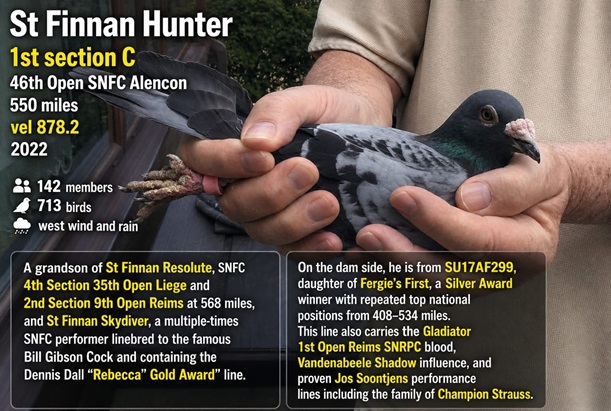
Resolute produced St Finnan Hunter, and Hunter became a real character. After returning from Wakefield after eleven days, badly affected and covered in oil, he was given another chance. The following year he returned from Maidstone with no tail, but I still believed in him. In 2021 he repaid that faith by winning 1st Federation, 1st Section C and 46th Open SNFC Alencon, 550 miles.
After the 2023 Gold Cup he returned badly injured, but Sandra and I decided to nurse him back to health. We always felt he had the heart of a lion. When eventually paired to St Finnan Grace, they produced St Finnan Ace, who won 5th Section, 19th Open SNFC Alencon in 2025 and the Kardale Trophy as the leading yearling over 500 miles.
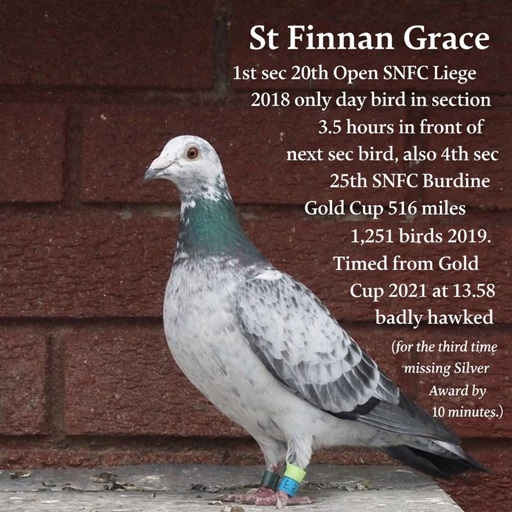
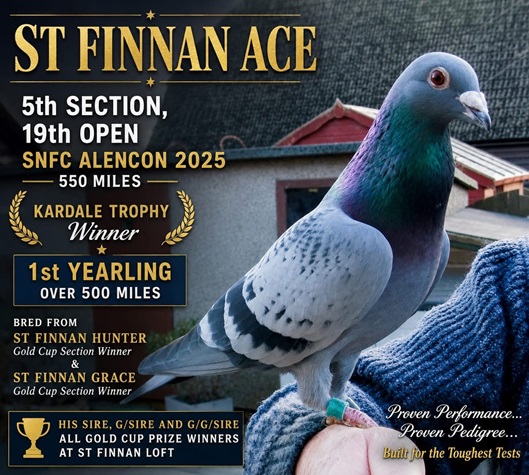
Grace herself came from Sweetheart and John Ellis’s “Reims Cock”, bringing together the Wellbank Prince, Reliable, Faithful and Endurance lines. Grace proved herself at the highest level, winning 1st Section, 20th Open SNFC Liege in 2018 and later becoming a valuable stock hen.
Her daughter St Finnan Sandra has been exceptional, winning a Gold Award in 2026 after five consecutive top Gold Cup performances:
- 10th Section C, 69th Open — 2022
- 3rd Section C, 11th Open — 2023
- 8th Section C, 42nd Open — 2024
- 11th Section C, 42nd Open — 2025
- 7th Section C, 24th Open — 2026
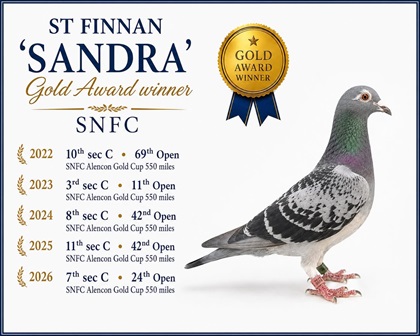
That makes five consecutive years of outstanding Gold Cup performances, and Sandra became the fifth Gold Award winner in her pedigree.
A more recent introduction to my loft from Jock McKenzie, a full brother to Mumpy, has proven his worth. He hasn’t changed the direction of the loft; he has strengthened it. His influence has added a touch of modern sharpness at the 500–600-mile mark, and when paired back into the established family, those qualities have blended naturally with what was already there.
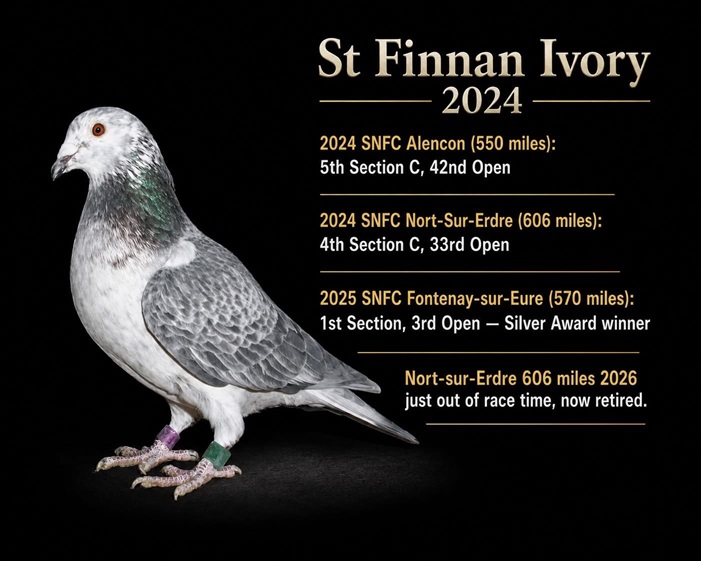
When paired to Sandra she produced St Finnan Ivory, who won 5th Section C, 42nd Open from Alencon, followed by 4th Section C, 33rd Open from Nort-sur-Erdre, 1st Section, 3rd Open from Fontenay-sur-Eure and the SNFC Silver Award.
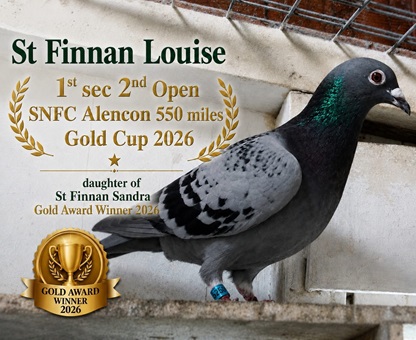
And, most recently, Sandra produced St Finnan Louise (2), who won 1st Section, 2nd Open SNFC Gold Cup Alencon in 2026 as a two-year-old.
Looking back, the visits to Jim Donaldson and John Ellis were hugely important. They brought together some exceptional Scottish distance blood, and over the years those lines have continued to prove themselves at 500, 600 and 700 miles.
Would you say Jim Donaldson and John Ellis were among the finest fanciers you ever met?
Jim Donaldson of Peterhead stands among the finest pigeon men Scotland has produced. His pigeons had a natural constitution that wasn’t the result of luck or fashion, but decades of disciplined selection. Donaldson birds didn’t just win; they improved the lofts they entered. They became renowned for stamina, channel reliability, natural health and a calm temperament-the type that could maintain its quality generation after generation.
Jim was one of those rare fanciers whose influence can be measured not only by his own results, but by the success of others who built their families around his blood.
John Ellis of Wellbank was a breeder in the purest sense. His pigeons were genetically consistent and predictable-the hallmark of a man who had built a family, rather than simply collected good pigeons.
I remember expressing my sympathy to John after the loss of one of his top pigeons. His reply was simple: “Don’t worry, another will be along soon.” That wasn’t bravado; it was the quiet confidence of a man who knew his loft would continue to produce quality because the genetics were firmly established.
Ellis pigeons became renowned for their consistency and repeatable type across generations.
Jim Donaldson and John Ellis represent the very best of Scottish pigeon sport. Their influence extends far beyond their own lofts, living on through the pigeons and families they helped create.
You have certainly brought together birds with some exceptional ancestry. What are your thoughts on breeding to preserve and, where possible, improve those bloodlines?
A true distance family isn’t created in a single season. It is built over decades through disciplined selection, intelligent introductions and a deep understanding of inherited quality.
The aim isn’t simply to win one race. It is to develop a family capable of performing repeatedly at 500–600 miles and beyond, particularly when conditions become difficult.
Distance breeding is about inheritance rather than luck. A pigeon’s value shouldn’t be judged solely by what it achieves itself, but by what it is capable of passing on-stamina, constitution, intelligence, determination and the natural ability to find its way home.
One good pigeon can be exciting, but a family of good pigeons is something altogether different.
True genetic stability is demonstrated when performance continues through the generations. When parents, brothers and sisters, uncles and aunts, nephews and nieces all contribute winners or consistent performers, you begin to see the strength of a genuine family-where quality is inherited rather than accidental.
That depth is what makes a family so valuable. Individuals can have exceptional seasons, but a strong family provides consistency, reliability and the ability to keep producing.
Every generation has to be tested. Racing is ultimately the only real measure of quality.
Hard races reveal constitution, mentality and stamina. They show you what a pigeon is made of when conditions become demanding. Easier races can tell you something, but they don’t reveal everything.
A distance family must continue to be tested. If you stop testing the birds, you risk losing the very qualities that made the family successful in the first place.
New introductions should be elite racers-not one-day wonders, fashionable pedigrees or untested birds simply because they look good on paper.
Ideally, the pigeon has already proved itself at the distances you intend to race, and comes from a family where performance has been repeated over several generations. That gives you greater confidence that the qualities you are introducing are both genuine and heritable.
Compatibility is also important. The new pigeon must complement your own family in terms of distance ability, body type, temperament, recovery and constitution.
New blood should never be allowed to dominate an established family.
As a general principle, introductions should represent only a small proportion of the breeding loft until they have proved themselves. Around 10–20% is more than enough initially.
Your own family remains the foundation. The new blood is there as a tool to improve it.
Flooding a successful family with untested genes can quickly dilute its identity. Introducing new blood gradually allows you to test it properly without losing what you have already built.
A new introduction doesn’t need to produce dozens of youngsters before you know whether it has worked.
Test it through one or two carefully considered pairings and produce a small number of youngsters. You are breeding for evidence, not volume.
Look for vigour, mentality, stamina, recovery and, ultimately, performance. If one or two youngsters clearly improve the family, you have something worth developing. Those that don’t add value should not be allowed to influence the main family.
Once a successful cross has been identified, the next step is to bring those improved qualities back into the core family.
Breeding back into your established line over two or three generations can help stabilise the improvement, fix desirable traits and prevent the introduction from gradually diluting the original family type.
The objective is enhancement, not replacement.
A great racer isn’t automatically a great breeder.
A pigeon may win major races and still fail to reproduce that quality. Equally, some of the most valuable breeders may never have achieved the greatest racing performances themselves.
The foundation loft should therefore be built around pigeons that have demonstrated their ability to produce winners and consistent performers.
Breeding ability is the real gold.
A dynasty cannot depend on one golden pair.
The foundation loft should contain several strong male and female lines, each supported by proven performance through multiple generations.
This creates depth and stability. If one branch weakens, another can carry the family forward.
That depth is one of the great strengths of a genuine distance family.
Pairings should be based on proven compatibility and complementary qualities while always protecting the identity of the family.
You are pairing traits, not simply pigeons.
Look at what each bird brings to the mating. One may offer stamina and constitution, another intelligence, recovery or proven breeding ability. The aim is to complement strengths rather than chase extremes.
Balance is the key to producing reliable distance pigeons.
Foundation breeders thrive in a stable environment.
Calm handling, consistent feeding, good hygiene and low stress all contribute to fertility, health and breeding performance. Stability allows good genetics to express themselves.
Record keeping is equally important.
Document pairings, youngsters, race results, health, behaviour and breeding outcomes. Over time, these records become a map of your family.
Knowledge builds families. Guesswork can destroy them.
Every generation must eventually face the basket.
Racing helps preserve the sharpness, stamina and mentality that define a true distance family. Without testing, there is always a danger that the qualities you have worked so hard to develop will gradually weaken.
Selection is not always easy, but it is essential.
Weak constitutions, poor recovery and inconsistent performance cannot be ignored simply because a pigeon has a good pedigree or has produced an attractive youngster.
Every breeder must ultimately justify its place in the loft.
Emotion can cloud judgement. Discipline keeps a family moving forward.
Distance breeding is a long-term project.
Every pairing should be considered not only for what it might produce this season, but for where it could take the family five or ten years from now.
Short-term thinking can produce winners.
Long-term thinking builds dynasties.
A true distance dynasty is built on consistency, discipline and a clear sense of purpose. The identity of the family must be protected, while new blood is introduced slowly, tested carefully and only retained when it genuinely improves what is already there.
A dynasty isn’t built through luck. It is the result of a lifetime of careful decisions.
Ultimately, the principle is simple:
Race every generation. Select from proven performance. Protect the identity of the family. Introduce new blood carefully. Pair for traits rather than fashion.
Do that consistently, and you give yourself the opportunity to build something much greater than a single champion pigeon-a family capable of enduring, improving and performing for generations.
A pigeon’s greatest value may not be what it does once, but what it consistently produces.
The safest investment is a proven breeder from a family in which excellence has repeatedly appeared across generations.
Thank you for sharing your thoughts on building a family capable of producing birds that can put up multiple performances at the long-distance events. Is there anything else you would add about how you motivate these birds to encourage them to produce those repeat efforts?
Motivation is the invisible force behind every top performance. A pigeon has to want to come home, and when that motivation is right, a good pigeon can become a great one.
The mate is probably the strongest natural trigger. The nest, whether it’s eggs or youngsters, can sharpen a pigeon’s focus and urgency. Routine is important too, because pigeons thrive on rhythm and predictability. There’s also trust-a pigeon races for the loft and for the fancier it feels bonded to.
I think emotional stability matters as well. Calm handling, no unnecessary shocks and no sudden changes all help keep the pigeon settled.
Motivation isn’t about shouting, forcing or using tricks. It’s about building that quiet bond between the pigeon and the loft-that feeling of safety, belonging and, when the time comes, the desire to get home.
A pigeon with ability and condition will perform. But a pigeon with ability, condition and motivation can excel.
You mentioned that pigeons have to really want to come home. Losses this season have been particularly heavy from the cross channel events. Presumably, many of those birds also had every intention of getting home. In your opinion, what was it that made this season so challenging, and were there any particular factors that you feel contributed to the high losses?
Forecasting the France–Scotland racing corridor has become a far more difficult exercise than it was 20 or 30 years ago. The atmosphere appears increasingly unstable, the jet stream is more erratic, and weather systems can develop and intensify with remarkable speed. The difficulty is not simply predicting what the weather will be at liberation time-it is anticipating what those conditions may become several hundred miles later.
Heat and humidity across France can now be considerably greater, creating conditions capable of producing sudden convection, fog and storm cells. Weather patterns that once seemed unusual can develop rapidly, leaving very little margin for error when planning a long-distance liberation.
The Channel presents another major challenge. Visibility, wind direction and atmospheric pressure can change quickly, and conditions in the Channel can be very different from those experienced on the continent only a few hours earlier. For a pigeon racing 500 or 600 miles, those changes can be decisive.
Then there is the jet stream. When it dips or stalls, it can produce prolonged periods of poor weather over Britain, while simultaneously creating significant changes in wind patterns along the racing route. A pigeon can leave France under one set of conditions and encounter something entirely different by the time it reaches the Channel.
Pressure systems also appear to move and develop more rapidly, which makes even a 12–24-hour forecast less certain than many would like to believe. That raises an uncomfortable question for the long-distance fancier: how much confidence should we really place in a forecast when the atmosphere itself can change dramatically after the decision to liberate has already been made?
Extreme weather events are also becoming an increasingly important consideration. Forecasting models have improved enormously, but they can still struggle to predict the precise timing, location and intensity of rapidly developing events. For the National race organiser, that creates a difficult balance between giving the birds an opportunity to race and recognising when the atmosphere has become too unpredictable to take the risk.
Perhaps the biggest change is that we can no longer look at a forecast as a fixed picture of what lies ahead. For a pigeon flying for 10, 12 or 15 hours, the real question is not simply “What is the weather like at liberation?” but “What atmosphere are we asking the birds to fly into as the day develops?” That distinction, in my view, has never been more important.
You’ve had a lot of success from the Belgian race points, such as Liège and Burdinne. Do you think there’s a discussion to be had about whether these races could actually produce better returns for the Scottish long-distance fancier?
Even at the same mileage, France can be a different proposition from Belgium.
France tends to warm earlier and faster, bringing hotter air masses, while inland routes can often involve more headwinds, particularly from the north, northeast or east. Birds may also have to cross large forested areas, such as Fontainebleau and Compiègne, as well as long stretches of open agricultural country where there are few obvious landmarks to aid navigation.
Visibility can become another factor, with haze, humidity and heat shimmer making orientation more difficult. Then, as the day wears on, the heat can begin to take its toll, with birds tiring and their pace slowing dramatically.
So, in my view, 500 miles in France is not necessarily the same race as 500 miles in Belgium. The mileage may be identical on paper, but the demands placed on the pigeon can be very different.
Racing today is becoming increasingly difficult because of the weather patterns we are facing. If that is the reality, perhaps we need to look at the situation more seriously. We have some of the best minds in the sport, and I believe there is a real discussion to be had about putting those heads together and asking whether we are preparing and racing our pigeons in the right way for the conditions they now face.
Unfortunately, the erratic racing and unpredictable returns haven’t been confined to the cross-Channel events, with many federations reporting several ‘disasters’, particularly with young birds. Do you feel there is anything we can do to better understand the reasons behind this and, more importantly, reduce the losses?
This season has been defined by unpredictable weather breaks and violent, rapidly changing winds. Even strong, experienced pigeons have been caught out. So the question is: what can we control when the environment is beyond our control?
For me, one of the biggest dangers for young birds is immaturity under pressure. They are often asked to race before their route memory, judgement and confidence are properly developed.
There is a strong argument for mixed-age racing. Older pigeons provide a natural education: young birds learn the line, remain calmer when the pack breaks, are less likely to drift and gain confidence from following experienced birds home.
Young birds need experience, but they also need time to mature.
Any-age racing could be the middle ground- giving youngsters valuable experience without exposing them too early to the pressures of young-bird-only racing. Ultimately, we should be developing pigeons, not simply testing them before they are ready
If we had any-age racing, I would also like to see midweek races introduced, perhaps capped at 60 miles. Old birds could use them as a useful training exercise, while youngsters would gain valuable racing experience with a much lower risk of loss.
That could have a significant long-term benefit. We would be educating young birds, conditioning our old birds and, ultimately, strengthening the teams going into future Nationals-while hopefully avoiding the sight of half-empty transporters.
There would be a financial benefit for fanciers too. With a regular midweek race available, many would have less need to spend money on private training tosses.
It could be a simple change, but one that benefits the birds, the fanciers and the future of National racing.
A few different perspectives there to consider. Do you feel peregrines also contribute to the problems we’re seeing, particularly when it comes to losses and disrupted returns?
Predators can influence a race far more than most fanciers realise, and tracking technology is finally giving us an insight into how they do it.
They don’t simply take pigeons out of the race; they can reshape the race itself-affecting the line, altitude, speed, drift and ultimately the total distance a pigeon has to fly.
A race advertised as 550 miles is rarely a straightforward 550-mile journey. A pigeon may be forced off its intended line and have to make significant corrections, potentially adding many miles to its journey. The extent of that displacement can vary enormously depending on the conditions and the decisions the bird is forced to make.
Predator pressure doesn’t simply remove pigeons from a race-it can reshape the entire race line. That is something we perhaps need to understand much better when we consider modern racing and the increasing difficulty of getting pigeons safely home.
On the subject of the race line, do you feel that a loft’s location and the line of flight are significant factors in long-distance racing? How much influence do you think they can have on a pigeon’s chances of success?
Loft location can shape a reputation more than most fanciers are prepared to admit. Some positions can benefit considerably when the race line drifts east, and prevailing westerly winds can exaggerate that advantage. As pigeons become tired late in a race, they can be more inclined to move towards the east rather than maintain a perfectly straight line, so a loft in the right position can become very influential.
That doesn’t mean the location is always dominant. It is only an advantage when the federation route and prevailing weather patterns work in its favour. There is no doubt that some fanciers have moved to, or established themselves in, locations that have produced particularly good National results. They were undoubtedly good fanciers, but their achievements may have been noticed even more because of the position from which they were racing.
Birds also have the advantage of being able to recognise and follow obvious geographical features such as coastlines, which can influence the line they take.
So, yes, I believe a good loft position can help. You will often hear fanciers talk about the ‘golden mile’, and there is some truth behind the expression. But location cannot create a champion family, nor can it turn an average fancier into a consistent winner.
Perhaps the more interesting fanciers to study are those who quietly produce outstanding results from positions that, on paper, should be more difficult. That is something I think we should take into consideration when analysing performances or deciding whether a family of pigeons is genuinely worth introducing into our own stock.
With this in mind, do you feel that velocity in yards per minute really tells the whole story?
Over the course of a race, a pigeon does not maintain a fixed velocity. As the distance increases, average speed naturally declines as fatigue, muscle stress and depletion of energy reserves begin to take their toll. Shorter-distance pigeons are timed before this biological decline becomes fully pronounced, whereas the further-flying birds are being judged during the stage of the race when their speed is already beginning to fall away. The further-flying birds are also racing through a very different part of the day. They encounter cooling temperatures, fading light, increasing ground haze and, at times, strengthening head or crosswinds as the weather pattern develops. They have more route decisions to make, more corrections to negotiate and are far more likely to spend extended periods flying alone. The consequences of even a small navigational error become increasingly significant. At 600 miles, a seemingly insignificant deviation from the most efficient line can add valuable miles and minutes-and, in a difficult race, can ultimately be the difference between being timed in and not returning at all.
Yet the results are still calculated almost entirely on raw velocity, with no allowance for the additional distance, time in the air or deteriorating conditions encountered by the furthest-flying birds. In that sense, the long-distance pigeon carries a natural handicap from the moment the race begins. It is not a flaw in the system; it is simply the way pigeon racing has traditionally measured performance. But perhaps it is worth asking whether raw velocity alone tells the whole story when comparing performances across dramatically different distances.
Your response does a good job of highlighting the difficulty faced by a long-distance pigeon flying on its own, long after many of its competitors have already been clocked. What physical traits, if any, do you feel a pigeon needs to possess to be capable of performing at this level?
A pigeon capable of flying alone at 500–700 miles must have a specific build that allows it to maintain lift, conserve energy, and resist fatigue long after normal race birds have reached their limit.
the ability to maintain forward progress without burning fuel too fast This is why many true distance pigeons feel “lighter” and fly with a steadier, less frantic wingbeat have strong oxygen utilisation
This is the difference between a bird that can fly 8 hours and one that can fly 14. you feel it in the bird’s buoyancy, calmness, and recovery speed. Silky, tight, low‑drag feathering is essential. A lone bird often faces cooling evening air rising humidity drizzle or haze poor feathering increases drag and heat loss, which destroys endurance.
A marathon pigeon must have a strong, rigid back tight vent bones stable shoulder girth this prevents wingbeat collapse late in the race. Weak backs these birds fade at 400 miles.
A lone bird must breathe cleanly and silently any obstruction reduces oxygen intake and kills stamina. This is why the best distance birds have open, clean nostrils calm breathing bright, oxygenated eyes
The ideal shape tapering, aerodynamic body no deep keel no heaviness a lone bird must be able to maintain rhythm without fighting its own weight. avoid anything that feels “heavy in the hand” or carries excess depth of keel respiratory weakness destroys endurance faster than any other trait.
The Magnetic Compass
I don’t see this as a theory. In my view, it is one of the single most important traits in long-distance racing, and interestingly, I believe many breeders have been selecting for it for generations without actually realising it.
It is the hidden engine behind line steadiness, independence, early arrivals and consistency over many years. And, in my opinion, it all comes back to the eye.
Think about the great distance families, both old and modern. They were built by fanciers who consistently kept the pigeons that arrived on their own, came through difficult races, or simply made it home when others didn’t. They weren’t necessarily selecting for a particular type, eye, wing or even character. They were selecting for something much deeper-the ability to navigate and orientate successfully under pressure.
Science has given us a much better understanding of how pigeons sense and use the Earth’s magnetic field. The eye is believed to play an important role in this magnetic sensing, acting, in simple terms, like part of the pigeon’s compass.
So perhaps the old-fashioned method of selection was actually telling us more than we realised. If you repeatedly keep the pigeons that come home alone, perform in bad races and find their way home when others fail, you may unknowingly be selecting for one of the most valuable attributes a long-distance pigeon can possess -the ability to orientate and stay on line when the going gets difficult.
In your experience, do you feel that true long-distance pigeons naturally tend to have the silky feathering you mentioned?
Yes, one thing most good fanciers would agree on is the importance of feather quality. If I take a piece of paper and slide it along a table, then polish the table and do the same again, the paper would more than likely travel the full length of the table. It is a simple analogy, but it illustrates the importance of reducing friction.
When a pigeon feels as though it simply “slips through your hands,” you are not just feeling softness. You are feeling reduced friction, a tight feather vane structure, good natural oiling and that fine, almost microscopic alignment of the feathers. In the air, all of these qualities can contribute to reduced drag, lower energy expenditure and, ultimately, greater endurance.
This is why, in my opinion, your distance birds-particularly those bred to race 600 miles-must possess exceptional feather quality. It is not simply cosmetic; it is an important part of the overall package. Any introductions into the family must possess this quality.
Speaking of endurance brings to mind the great pigeon of John Ellis, “Endurance”, winner of 1st Section, 27th and 82nd Open British Barcelona Club from Palamos, a race of 1,044 miles. John told me that, with hindsight, he felt it was simply too far for a pigeon.
I thought about that when “Ivory” arrived this year from Nort-sur-Erdre, 606 miles, in 2026, outside race time. The distance itself was not necessarily too far, but the changing climate and conditions we now face mean that we have to prepare our birds for every eventuality. In that particular situation, the high-fat diet before basketing may well have been beneficial, perhaps giving her the energy reserves to keep pushing when others had reached their limit.
However, the pigeon must have the ability to utilise those reserves. This brings me to something I experienced through swimming.
Many years ago, one of our daughters was a top swimmer. During training, she and other swimmers were asked to provide blood samples so that their lactate levels could be measured after hard exercise. The idea was to assess how their bodies coped when the muscles were working under pressure.
The interesting thing was that the top athletes tended to produce less lactate at the same workload. Their muscles were able to use oxygen more efficiently, utilise energy more effectively and recover more quickly. In simple terms, lower lactate levels were associated with a greater capacity for endurance.
I believe there is a parallel with our pigeons. I remember a swimming coach telling me that these tests could identify the swimmers who had the potential to become elite athletes. However, those results were never given to the parents.
Perhaps nature has given us something similar in the pigeon. We cannot see the figures or measure everything that is happening internally, but through careful observation, breeding and performance, we can identify the individuals that possess that extraordinary ability to keep going when others have reached their limit
You’ve spoken about the compass aspect of the eye. Beyond that, do you attach much importance to the pigeon’s eye in terms of eyesign, or are there other features of the eye that you look for when selecting your long-distance pigeons?
I always enjoyed my visits to Jim Donaldson. Sandra and I were always made very welcome, and any conversations we had with Jim about pigeons were constructive. He was always interested in your opinion and would ask what you thought about anything and everything relating to the birds.
I always say Jim started at the top. I remember a visit to Dennis Dall, where Jim took a liking to a blue bar cock who became known as “The Dall Cock.” What a producer he turned out to be. Dennis told me he was bred from his best racing hen, who had herself won 214th SNFC Sartilly, 40th SNFC Nantes and 39th SNFC Niort, 693 miles. She was paired to a cock Dennis had purchased at an SNFC sale, bred by Hugh Brown of Stenhouse.
Jim was open to discussing every aspect of pigeon racing, and the much-debated subject of eyesign was certainly one of them. Like myself, Jim only looked for one eye. First and foremost, the breeder had to be impeccably bred, and even better if it was an outstanding racer. Only one of the pair needed to possess this particular eye, but the other had to be a top racer from a long line of the same.
John Ellis, however, would usually say, as I handled his birds, “You’d be better looking up its arse!” We always laughed at that.
Many top fanciers visited John, and I know that when one of them looked into the eyes of his birds and made a comment, John would always take note. But, as John himself said, only if that person was a top National flyer.
Eyesign has always been a controversial subject. Back in the 1960s, we had huge entries in the shows, and the Edinburgh Show was the main event at the time. I remember one of my clubmates winning it, which came as no surprise because he was very knowledgeable about eyesign. However, when it came to racing, he was nowhere to be seen. The problem was that he had become obsessed with eyesign and seemed to overlook everything else.
I remember him talking about one of his Nantes birds. When you asked about the pigeon, you would have found it had taken a week to get home!
John was one of the nicest men you could ever meet, but being a nice man doesn’t win races.
There is another interesting aspect to eyesign that I think is worth considering. A colour-blind fancier and a fancier with normal colour vision are not necessarily looking at the same eye. They can literally see different colours, contrasts and, in some cases, different patterns. Perhaps that is one of the reasons the eyesign debate has continued for more than 100 years: we don’t all see the same thing.
I have seen so-called eyesign men visit lofts and give not opinions, but definite statements: “This bird is good for this, “or “That bird is good for that.” In my experience, they are very often found wanting when it comes to the races.
For me, eyesign can be interesting, and I’m certainly open-minded about it, but I would never allow it to override performance, breeding, constitution and the qualities that a pigeon demonstrates when it is actually asked to race.
Onto another topic now, and one that is occupying the thoughts of most fanciers at this time of year. Can you tell us how you manage your pigeons through the moult and then through the winter period, leading up to pairing?
For many fanciers, the racing season takes centre stage. Yet, arguably, the period that has the greatest influence on next year’s results is the moult. It is not simply a rest period; it is a rebuilding phase, when every feather is replaced with new aerodynamic equipment.
A pigeon’s performance is aided by the quality of its feathers, and the moult is where that quality is created. Each feather is a finely balanced structure, designed to provide lift, stability, waterproofing and durability. Poor feather quality can ultimately compromise racing performance, regardless of breeding or training.
During the moult, the bird invests an enormous amount of energy in producing these new feathers, and the fancier’s job is to support that process with the right nutrition, minerals and environment.
Feathers are composed of roughly 90% protein, but it would be a mistake to assume that simply feeding large quantities of protein will improve the moult. What pigeons really require are the correct amino acids-the building blocks from which feather is produced. Overloading birds with crude protein can place unnecessary strain on the system and may lead to wet droppings, lethargy and an uneven moult.
Balanced feeding is the key. The aim is to provide the right nutrients and amino acids without unnecessarily burdening the bird.
A good moulting mixture should contain small, controlled amounts of seeds such as:
- Linseed – helps promote feather condition, shine and flexibility.
- Hemp – contributes to feather strength and elasticity.
- Rapeseed – helps support feather quality, tightness and waterproofing.
These seeds can enhance feather finish and durability without relying on excessive protein levels. The moult is a marathon, not a sprint; steady, balanced support will always produce better results than trying to force the process.
Although feathers themselves are predominantly protein, the follicles responsible for growing them also depend heavily on minerals. Without adequate mineral intake, the bird cannot produce strong, uniform feathers.
Daily access should be provided to red grit and a mineral pickstone. I prefer to offer these freely and allow the birds to regulate their own intake. There is no need to continually replace them when they are still clean and usable-the birds will let you know what they require.
Some fanciers prefer to save money by buying beans, barley and other grains directly from farms. There is nothing wrong with this approach, provided the grain is clean, dry and properly stored. The problem is contamination. Mice, rats and their droppings can quickly ruin feed and, potentially, an entire season.
Feed should always be stored in tightly sealed bins in a clean, dry area, with appropriate rodent control in place.
Vermin prevention must be proactive. Waiting until you actually see mice or rats means the problem may already have begun. Contaminated feed can destroy a loft’s condition far quicker than many fanciers realise.
As for winter management, I only separate the sexes for a few weeks before pairing, usually in late February or early March. For the rest of the winter, I prefer to maintain natural behaviour and a calm environment, while still giving the birds that short separation period before breeding begins.
Winter is also a time when we must do everything possible to keep the loft dry. Dampness is the enemy, so ventilation and cleanliness are particularly important. All feeding and drinking utensils will also benefit from a thorough weekly scalding with boiling water. Good hygiene costs very little, but it can make a considerable difference to the condition of the birds going into the new season.
When I visited your loft, I noticed your approach to bathing the pigeons-or perhaps I should say showering them. Can you explain how you go about this and why you prefer this method?
I do this regularly throughout the moult, but I find it works particularly well after a race. When the birds return, I give them a shower using the garden hose with a sprinkler attachment. It immediately flushes away the dust and other particles they have picked up during the race.
Birds can come home coated in dust, dried sweat and feather debris. A light, clean spray removes all of this without them having to sit in dirty bath water.
It also encourages natural preening. After a race, they want to realign and condition their feathers, and I find that a gentle, rainfall-style mist triggers that instinct perfectly. You can see them perk up, shake themselves out and start working on their feathers, particularly around the wing butts and oil gland.
I also believe it helps prevent stiffness. The cool mist seems to relax them, much in the same way that a cool rinse can help an athlete after exercise, helping them recover from the exertion of the race.
Most importantly, there is little risk of chilling them. A conventional bath can leave a tired pigeon soaked and cold, whereas the sprinkler method lightly wets the feathers rather than saturating the bird. They dry quickly, remain warm and, importantly, they are not drinking contaminated bath water.
You are clearly very good to your birds, Joe, and I can see why they repay that care. Do you feel that the bond you and Sandra have with your pigeons is important to your success, and has it allowed you to gain something from the sport that goes beyond simply winning?
I have taken great enjoyment from our feathered friends throughout my life. To me, they are a gift from God, and with that gift comes responsibility. Anyone who has truly worked with birds soon learns that respect is not optional; it is the foundation of everything.
When we provide them with the right environment, patience and care, they respond with trust, character and a spirit that can lift the human heart. In return for our respect, they give us purpose, companionship and moments of quiet wonder that stay with us for a lifetime.
I believe the sport will survive because it still offers something unique. No other hobby gives you the thrill of seeing a bird return from hundreds of miles away, the bond between man and animal, the craft of breeding, the challenge of improving a family, the history and tradition, and the quiet satisfaction of working alongside nature.
As long as people continue to value those things, pigeon racing will endure.
As far as your racing career is concerned, Joe, are there any particular memories that really stand out for you?
I recall the arrival of “St Finnan Angel”, who won 1st Section, 2nd Open Fife Federation and 2nd Section, 24th Open Scottish National Flying Club from Eastbourne, against 4,568 birds in 2011. Her performance gave me the confidence that the Donaldson × Ellis cross had been a success.
She was followed by “St Finnan Arrow”, winner of the Kardale Trophy with the Scottish National Flying Club in 2013. She also finished 11th Section and 32nd Open SNFC Gold Cup from Alençon, a 550-mile race with 1,355 birds competing. Remarkably, she was the only yearling to make the result.
Then came “St Finnan Grace”, who became my most outstanding racer. In 2018, she won 1st Fife Federation and 1st Section C in the SNFC Gold Cup Blue Riband race from Liège, Belgium, a distance of 525 miles. She was the only bird home on the day into the section, arriving three and a half hours ahead of the next bird in Section C .
While going for her Silver Award, Grace returned badly hawked and missed out on the award by just 10 minutes. Grace is now the mother of the loft, and her influence can be seen throughout the family today.
I have been fortunate to experience many great moments in this sport, but the quiet moments spent in the company of our feathered friends tops the lot.
Grace was a bird that certainly made an impression on me when I visited your loft. I remember you mentioning that she spent a lot of time on her own. Can you tell us a little more about Grace and, in your experience, what can help feel make a long-distance pigeon good as an individual?
One trait Grace certainly had was her ability and willingness to fly alone. We would often see her break away from the team and disappear on her own, only to return from a completely different direction, sometimes an hour later. She might swoop over the loft and then disappear away again. It was something she regularly did, and I always felt it was an important characteristic..
On occasions, in the build-up to the Nationals, I would get up early, basket the chosen candidates and liberate them around 30 miles away, just before daybreak. They would sometimes alight on a rooftop and sit there for a while before eventually making their way home. Of course, that carried a degree of risk, but that is part of the game you can imagine them sat on a roof agitated to be on their way home.
A great number of pigeons are flown only in flocks. A fancier may have a team of 40 birds who fly around the local district as a team and then they are tossed as a team.. It is quite possible that by the time these birds are three years old, they have always been arriving from their federation races in a batch, potentially only being asked to fly on their own for a few miles, they have very little experience of flying independently. So, when you put them into a National race of 500 or 600 miles, can you really expect every one of them to cope when they suddenly find themselves having to fly 200 miles or more on their own?
I believe single-bird training from an early age is very beneficial if you intend to race Nationals. Even something as simple as letting a bird out of the loft on its own occasionally is a start. You are teaching it to become an individual rather than always relying on the flock.
I remember George Ritchie of the Ritchie and Whyte partnership, with the famous “Storm Queen” family, sending me a basket of pigeons and asking me to single them up over a period of hours, covering 103 miles. That certainly made an impression on me.
If you want to reduce your numbers, try it. Pigeons can quickly become like a sheep, constantly looking for another bird to follow. The quicker you teach them that they are individuals, the better. And if a pigeon simply cannot cope when it is asked to fly on its own, perhaps it is better out of the team.
Some final thoughts
There are men in pigeon racing who chase easy wins, and there are men who build pigeons for the days when nothing comes easy. James (Joe) Mullen belongs firmly in the second group.
Spending time with Joe and listening to his thoughts has certainly given me plenty to think about. His loft produces the kind of long-distance pigeons that make other fanciers rethink what is possible-pigeons that rise to the occasion when the sky turns hostile and the miles begin to take their toll.
Joe’s approach to cultivating long-distance pigeons is not a theory, a trend or a borrowed system. It is the result of a lifetime of hard lessons, hard races and difficult decisions. Over many years he has shaped a family of pigeons through careful selection, testing, patience and perseverance-birds capable of performing when conditions become difficult.
His record speaks for itself, but perhaps what impressed me most was the philosophy behind it. Joe believes in allowing pigeons to develop, testing them honestly and selecting those that prove themselves when it matters. The influence of great individuals such as Grace is evidence it is working, and his family is the product of generations of decisions made around the loft.
As I said at the beginning, pigeon racing has very few absolute rights or wrongs. What works for one fancier may not work for another. But that is what makes conversations such as this so valuable. Joe’s ideas may challenge some conventional thinking, but they certainly provoke thought-and perhaps that is one of the greatest things we can ask of any answers.
For anyone who believes the sport still has room for genuine distance men, for those who breed for the hardest miles rather than the easiest wins, Joe Mullen’s story is one worth studying.
He didn’t simply race pigeons. He spent a lifetime building a family capable of finding their way home when the road became long, the conditions became difficult and nothing came easy.
My thanks to Joe and Sandra for their time, their hospitality and for allowing us an insight into the St Finnan family. Above all, I hope readers take from this what I have: that behind every great pigeon is a fancier willing to observe, learn, adapt and, perhaps most importantly, never stop thinking.
Lewis McCalley