Was it the bird, or the wind?
A free tool that predicts your race winner’s arrival — now calibrated for British Racing
By Morne Ahlers, Ahlers Loft, South Africa
Every fancier has stood at the loft on a hard day and asked the same question: was that great velocity down to the bird, or down to the wind? I built PigeonRaceAnalyser to answer it — before the birds are even up.
It is free. No sign-up, no app to install, and it works on any phone. You enter your loft’s location and the liberation point, and it does one thing well: it reads the wind along the whole flight line — not just at the release — and gives you a projected winning velocity and an arrival time for the race. In other words, it tells you what a good bird should do in the day’s conditions, so afterwards you can see whether your winner beat the wind or simply rode it.
How it works, in plain terms. The tool checks the wind at points all the way down the course, works out how much of it is a genuine tailwind or headwind for your race’s direction, and feeds that through a velocity model. That model isn’t a guess — it’s calibrated on several seasons of real, published English South Road results, so the projected speed reflects how birds have actually flown that region in similar wind, not a textbook formula.
Why I’m writing for a British audience. The tool now has three models built specifically for UK racing:
- Scotland — Ayrshire (South Road): built on five seasons of Ayrshire Federation results. Scottish racing is often into a headwind, and the model reflects that honestly — these are not sprint speeds.
- England — South Road: the largest of the three, built from well over a hundred inland English races.
- England National — Channel & North France: the long stuff, built on years of BICC, BBC and NFC-distance day races.
Enter your loft’s location and it even picks the right one of the three for you automatically.
A worked example — Yelverton, 23 May this year. An inland South Road day race from Yelverton in Devon, liberated at 7:45 in the morning. I set the tool to the England South Road model, entered the Yelverton liberation point and a North-West London loft about 180 miles out, and let it read the wind down the line. It was a near-neutral day — barely a breath of tailwind.

The set-up: England South Road model, Yelverton to a North-West London loft.
Before a single bird was liberated, it projected a winning velocity of 1,419 m/min — about 1,552 ypm — inside a band of 1,334 to 1,504 m/min, and first birds home at around 11:09 (a window of 10:57 to 11:22).
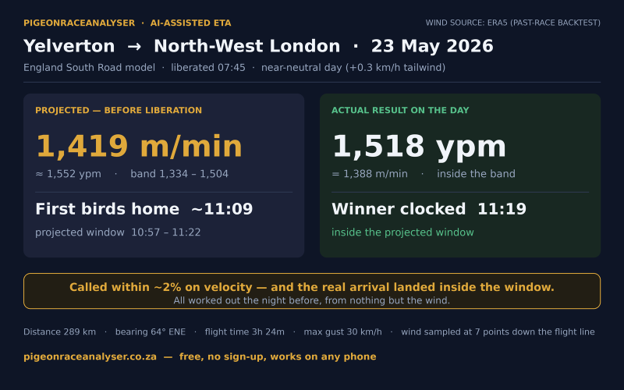
The projection, made before liberation, against what the winner actually did on the day.
When the race was flown, the winning bird clocked 1,518 ypm and dropped at 11:19 — inside the projected window, and within about two per cent of the projected velocity. Not bad for a figure worked out the night before, from nothing but the wind.
I’ll be straight with you about what it can and can’t do. It doesn’t know which bird is on form, and a freak thunderstorm will always have the last word. What it gives you is a well-grounded expectation of the day — and it sharpens with use, because any fancier can log his own winners and the model tightens to his own loft over time.
That’s the heart of it. It started as one man’s question at one loft, it’s used by South African clubs every basketing week, and now three corners of British racing have their own calibrated version — free, on the phone, no catch. If it settles one “good bird or good wind?” argument in your club, it has done its job.
Give it a run on your next race and see what you think.
PigeonRaceAnalyser is free at https://www.pigeonraceanalyser.co.za — questions welcome at